
Doc1_page-0001 (1)
SQAIL ... nimbly walking - finally again!
___________________________
for people with diabetes who suffer from neuropathy
previous arrowprevious arrow
next arrownext arrow

What is WINGO® wearable?

Wingo is a medical device in the form of a smart textile wearable. It consists of a hi-tech stocking with a sensor sole, a control unit, an app and accessoires. Years of extensive research form the basis for this unique product.

Gait phase synchronised muscle stimulation:

Wingo analyses your gait in real time and stimulates the right muscles at exactly the right moment. This supports your natural movement sequences and improves gait stability.

Vibration stimulation for nerves and muscles:

Gentle, precise vibrations strengthen weakened nerve functions and activate muscles.

Regeneration of blood vessels and nerves:

The vibrations promote blood circulation and blood flow in the legs. This supports the regeneration of damaged blood vessels and peripheral nerves - an important aspect for diabetics.

Compression therapy:

The combination of compression and vibration therapy creates the first wearable lymphatic drainage system. This achieves a gentle form of lymphatic drainage.
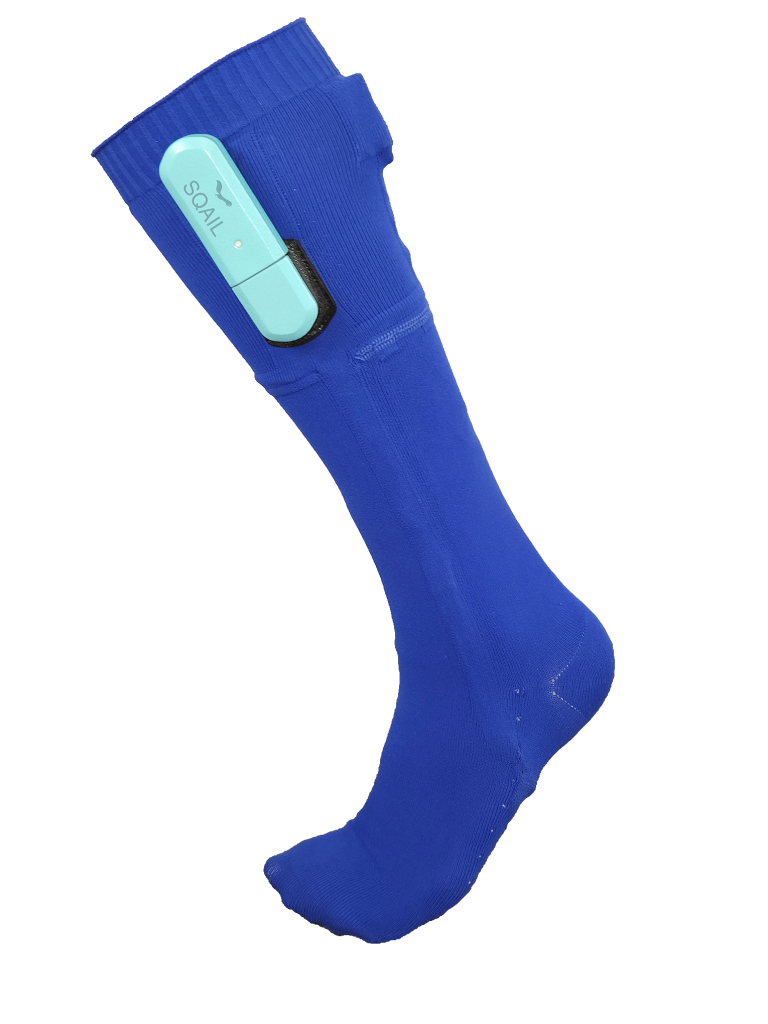
A revolutionary medical device for your legs


ABOUT US

Our mission as Sqail team is to address the global issue of people suffering from diabetic sensory-motor peripheral neuropathy (DSPN), which affects over 100 million diabetics worldwide, and to support these patients in their lives through medical products. The main problems these patients face are the loss of balance due to the loss of peripheral sensitivity and severe pain caused by neuropathic pain syndrome. That’s why Wingo was developed!

Wingo is a revolutionary bionic therapeutic and assistive device based on three pillars, built on the insights of the 2021 Nobel Prize in Medicine and the innovations of the founders of Sqail, and is now being introduced to the market. Wingo, as a bionic medical product, addresses gait disturbances in neurological deficits. Lost sensation is restored, pain is alleviated, walking security is regained, the risk of falls and the fear thereof are reduced. Wingo promotes an active life with increased mobility, ongoing muscle development, and improved long-term blood sugar regulations.

NEWS

Austrian Innovation for more quality of life – Sqail on the Expo 2025

Sqail is with the CEO Christian Bouda on the World Exhibition Austria at Expo 2025 Osaka at the Austrian Pavilion to introduce the Gear machine WINGO.

The world first to relieve neuropathic pain for people with polyneuropathy and improve gait stability.

Thanks to the teaam AUSSENWIRTSCHAFT AUSTRIA, and the great organization of the Pavillon Alf Netek 

Meet Christian Bouda, founder and CEO of Sqail:

To read more about what’s happening in the world and all Sqail related topics, visit our blog page

https://www.blogger.com/u/1/blog/posts/9123168093134829747

SQAIL Wins IÖB Project for Smart Textile in Pain Therapy

The company SQAIL has won the IÖB-sponsored project for smart textile in pain therapy. The innovative smart textile provides synchronous
muscle stimulation, supports the gait cycle, and stimulates muscle activity in
affected areas. Specially designed actuators account for individual physiognomy
and are integrated into washable socks, pants, or cuffs.

Source: ioeb-innovationsplattform.at

Findings of medicine nobel price used by WINGO

WINGO manages to make walking easier in everyday life and, ideally, to increase mobility without more effort. This strengthens health literacy, but also has other very positive effects on the regulation of this type of disease. By increasing the metabolic activity rate, the sugar level is reduced and thus the progression of diabetes is stopped or at least greatly attenuated. At the same time, the regular stimulations of the gait machine WINGO on the muscle parts set important therapeutic effects in the repair and regeneration of nerves and blood vessels, this was impressively demonstrated in the work of David Julius and Ardem Patapoutian  WINGO uses mechanisms based on these discoveries (Piezo-1, and Piezo-2 receptors) for temperature, mechanical stimuli and touch, for which Ardem Patapoutian and David Julius received the 2021 Nobel Prize in Medicine.

Source: nobelprize.org

CO-FOUNDER OF SQAIL with a review on vibration therapy

Vascular and Neural Response to Focal Vibration, Sensory Feedback, and Piezo Ion Channel Signaling

Penasso, H. Petersen, F., Peternell G. https://www.mdpi.com/2813-2475/2/1/6

Co-Founder and Chief Medical Officer Gerfried Peternell published a review on focal vibration therapy, which aims to restore tissue and nervous system function. The therapy involves using vibration to improve the health of residual limbs and prosthesis acceptance in amputees. The review combined research on various aspects such as vibration therapy, sensory feedback, and the recovery of blood vessels and nerves.

Key points include:

– Intermittent focal vibration helps repair and form blood vessels and nerves by increasing shear stress on endothelial cells and triggering Piezo1 signaling.

– Stimulating Piezo1 in peripheral nerves may reduce the growth of painful neuromas.

– Vibrotactile feedback influences the motor cortex and modulates sensory signals, aiding in recovery and reducing phantom pain.

The review recommends using focal vibration at frequencies of 60-120 Hz and amplitudes up to 1 mm to benefit motor control, locomotion, pain relief, nerves, and blood vessels, while avoiding adverse effects.

Pathognomonic changes in diabetic polyneuropathy

The video impressively demonstrates the typical alterations in gait that occur with the loss of peripheral sensitivity in the feet. Since the individual no longer feels when their foot touches the ground and cannot confidently shift their weight onto it, gait instability increases, and the fear of falling intensifies.

To maintain balance, the following typical compensatory mechanisms occur:

  • The walking pace is reduced – individuals walk more slowly
  • The stride is widened to increase the base of support
  • The feet are turned outward, also to increase the base of support
  • The gait becomes less dynamic; push-off at the end of the stance phase decreases, and the feet are lifted flat from the ground

In conjunction with the above points, this overall leads to a “waddling” gait, similar to that of a duck

  • Knee flexion during the swing phase decreases due to heightened uncertainty and fear. The knees are kept more extended to prevent a fall in case of tripping
  • Compensatory movements of the upper body increase to maintain lost balance. The gait becomes unsteady
  • Compensatory movements of the arms also increase, again to maintain balance and prevent a fall
  • Due to the uncertainty, the individual stays closer to the wall rather than in the middle of the room
  • During changes in direction and walking backward, uncertainty and the gait alterations mentioned above become more pronounced

This significantly impairs social participation and independent mobility in public spaces and transportation